
Ryan Tracy, PhD

Data scientist Social psychologist

Ryan Tracy

I'm a data scientist with a PhD in social psychology. I bring behavioral research and applied data science together to ask questions, test ideas, and build useful things.

I earned my BA from the University of North Carolina Wilmington and my MA from New York University, both in psychology. I then completed my PhD in social psychology and quantitative analysis from the City University of New York's Graduate Center under the tutelage of Drs. Steven Young, Eric Mandelbaum, and Daryl Wout.

My professional work is driven by a desire to blend my training in social and behavioral science with my experience building machine learning pipelines with big data.

From understanding people to working with data.

My training in social psychology focused on first impressions, face perception, decision-making, information processing, and bias reduction. My professional work spans predictive modeling, experimentation, entity resolution, forecasting, and end-to-end production data pipelines.

Throughout all my work, I aim to answer three questions: what are we trying to understand, how can we measure it, and what would count as useful evidence?

Much of the data I work with is behavioral: what people use, what they prefer, and the choices they make. Understanding perception, motivation, and cognition helps me ask what those patterns mean, not just whether a model can predict them. Not every technical task is a behavioral one, but when the data comes from people, understanding those people is part of understanding the data and the models we build.

Modeling & forecasting
Building predictive models and forecasts to make patterns in data useful for decisions.
Experimentation
Using experiments to investigate questions and evaluate the evidence for an idea.
Connecting & preparing data
Working on entity resolution and production pipelines so data can support reliable analysis.
How we perceive, process, and decide.

I study how people form impressions, interpret information, and make decisions. These areas help me understand where judgments come from, where bias enters, and what might help reduce it.

  • First impressions
  • Face perception
  • Decision-making
  • Information processing
  • Bias reduction

Gabbie

An AI-Integrated Workspace

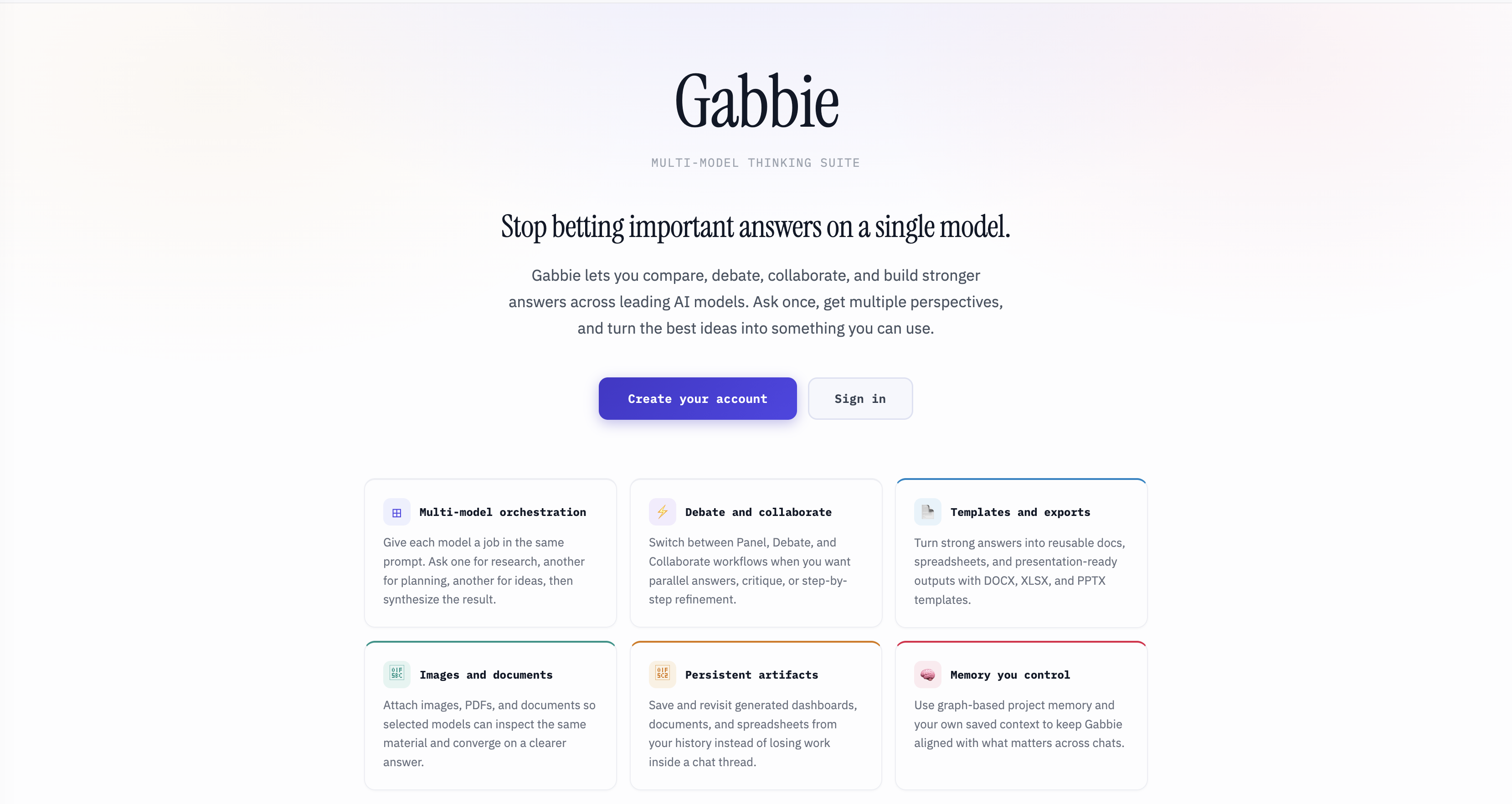
Gabbie's main page, with the headline 'Stop betting important answers on a single model' and an overview of its multi-model workspace.
Gabbie's main page.

Gabbie offers multiple perspectives on any problem. It offers a workspace where users can compare answers, work through disagreements, and bring their best ideas to life.

Features include:

  • Panel, Debate, and Collaborate modes
  • Image generation and editing
  • Data analytics
  • Independent and pooled web search
  • Graph memory and conversational intelligence
  • Model-specific reasoning controls and customization
  • Model lab for side-by-side comparisons of different releases of the same model family (e.g., ChatGPT)

New features are added weekly!

Built with AI coding assistance.

Let's talk.

I welcome conversations about data science, behavioral science, and people analytics.